Today marks the first-ever Paralysed Bowel Awareness Day, a crucial milestone in the fight to end the suffering caused by inadequate bowel care for spinal cord injury (SCI) patients. But let’s be clear, this isn’t a day of celebration. It’s a day that exists because the NHS is failing us, and people with SCI continue to face humiliation, neglect, and life-threatening complications due to a lack of trained healthcare professionals.
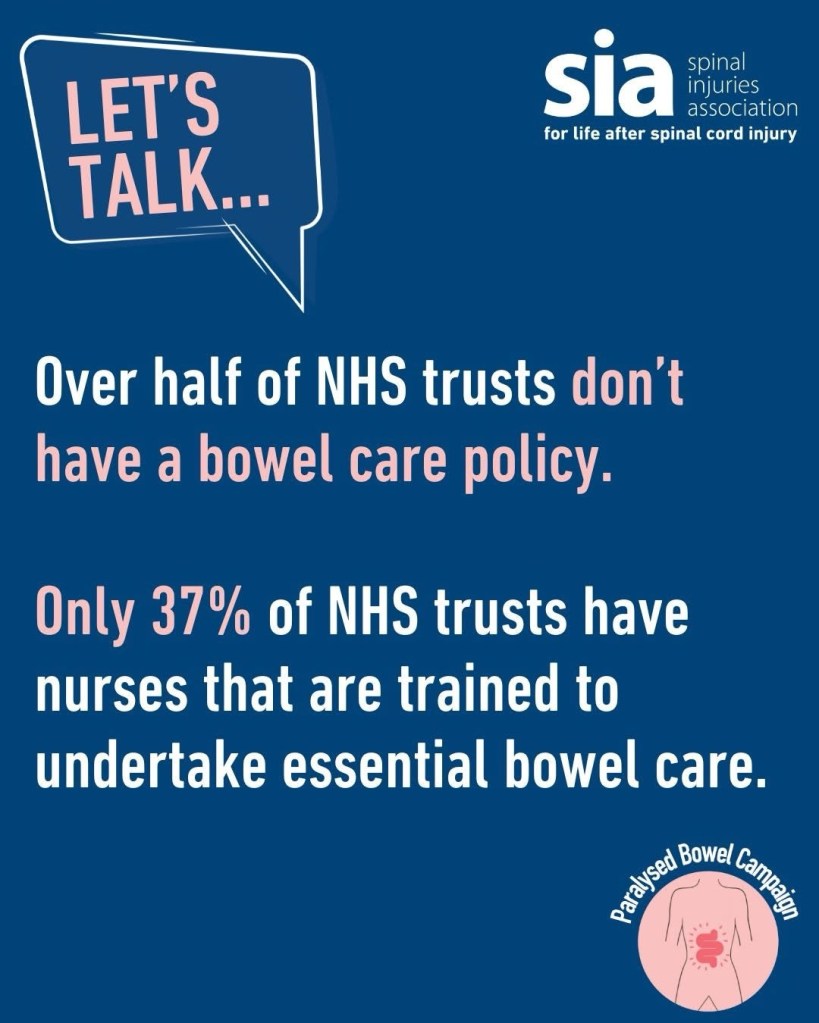
Right now, only 37% of NHS trusts have nurses trained to provide essential bowel care. That means the majority of spinal cord injured patients admitted to hospital cannot receive the care they need to safely and effectively empty their bowels. Without proper bowel care, patients can experience severe pain, chronic constipation, incontinence, infections, and even life-threatening conditions such as autonomic dysreflexia or sepsis.
Bowel care isn’t a minor issue, it’s a fundamental medical need.
The Reality We Face
Imagine being in hospital, completely dependent on others, yet being denied the ability to go to the toilet. You ask for help, but no one is trained to assist you. Instead, you’re re put in a nappy and told to relieve yourself in bed, left waiting for hours in your own excrement until someone is free to clean you up.
This isn’t a horror story. This is reality for far too many people with spinal cord injuries.
The Work of SIA: Fighting for Change
For years, the Spinal Injuries Association (SIA) has been leading the charge to fix this broken system.
▪️ In 2024, we rebranded our Serious Shit campaign to the Paralysed Bowel Care Campaign, in partnership with Hudgell Solicitors.
▪️ We provide essential care plans for anyone concerned about their bowel care in medical settings.
▪️ We offer specialist training to healthcare professionals, but we want to do more.
▪️ We want to help NHS staff challenge and improve their trusts bowel care policies, because if it isn’t good enough, it needs to change.

SIA has worked tirelessly to bring this crisis to Parliament. We hosted the Paralysed Bowel Care Roundtable in Westminster, where MPs acknowledged the urgency of this issue. Thanks to our advocacy, the health minister agreed to advance our key requests, including:
✅ Establishing Paralysed Bowel Care Awareness Day (happening today, February 10, 2025!)
✅ Ensuring every NHS trust has a dedicated nurse trained in paralysed bowel care
✅ Allowing personal carers to assist with bowel care in NHS settings
✅ Implementing an emergency care pathway for SCI patients
A Day for Action, Not Just Awareness
Today, as SIA gathers at the House of Lords, we are making sure that this issue stays at the forefront of political discussions. We look forward to working closely with the government to turn promises into real change.
But this is just the beginning. Too many patients are still suffering because the NHS does not have a clear, enforceable bowel care policy across all trusts. Our Freedom of Information request exposed the shocking reality:
▪️ Only 54 out of 123 NHS Trusts in England have a formal bowel care policy.
▪️ 26 trusts have no bowel assessment or management policy at all.
▪️ 40 trusts admitted they have no ward-based staff skilled in bowel care.
▪️ Only 21 trusts allow carers to assist with bowel care, even when no trained NHS staff are available.
These figures are unacceptable. Neglect is not an accident it is a systemic failure.
The Next Steps: We Wont Stop Until Theres Real Change
We know change wont happen overnight. But we are committed to:
▪️ Holding the government accountable – we have secured a meeting with the health minister to push for our remaining requests.
▪️ Working with healthcare professionals to ensure every NHS trust has a trained bowel care nurse and an enforceable bowel care policy.
▪️ Raising public awareness – because too many people with SCI feel too ashamed to speak out, even though their suffering is entirely preventable.
Enough is Enough
This isn’t about comfort it’s about survival. Its about dignity. Its about basic human rights.
People with spinal cord injuries cannot and should not be forced to endure the physical and psychological trauma of inadequate bowel care. If the NHS can train staff to administer insulin, perform CPR, and deliver chemotherapy, then they can and must train staff to provide essential bowel care.
The Royal College of Nursing agrees. The MPs and ministers we’ve spoken to agree. The patients suffering in silence know this has to change.
Now, it’s time for the NHS to act.
No more neglect. No more suffering. No more excuses.
Spinal cord injured people are not invisible. We are not an afterthought. We are here and we demand better.
 Life rewritten with Martin Hibbert
Leave a comment