In June 2014, during my stag weekend in Krakow, I visited Auschwitz-Birkenau. It was a trip I had long wanted to make. As a keen military historian, I felt compelled to see it firsthand, to try and grasp the scale of the atrocities committed there. I’d assumed it would be a deeply personal experience, something I would do alone amidst the usual revelry of a stag weekend. To my surprise, every one of my friends chose to join me. Their willingness to stand beside me during such a sobering journey is something I will always hold dear.
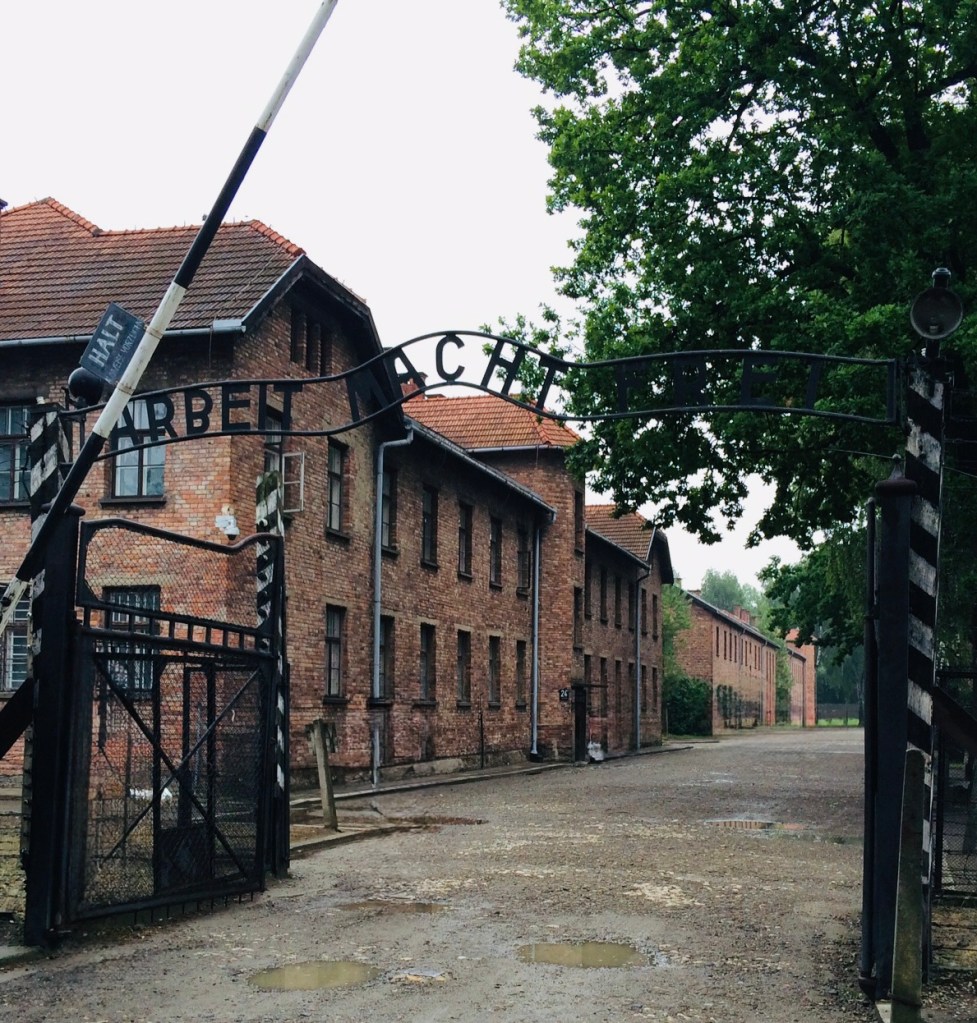
From the moment we arrived at Auschwitz-Birkenau, the atmosphere changed. The laughter and camaraderie that had defined the trip so far dissolved into a respectful silence as we approached the gates. Passing beneath the chilling inscription – Arbeit Macht Freiâ – Work sets you free, was a moment I’ll never forget. Even with my knowledge of the Holocaust, nothing could have prepared me for the overwhelming weight of stepping into that place.
As we walked the vast, desolate expanse of Birkenau, the sheer scale of it became painfully clear. The camp stretched endlessly in all directions, with rows of barracks and barbed wire fences disappearing into the distance. What struck me most was the silence. There were no birds flying overhead, no signs of wildlife. The entire area felt devoid of life, as though even nature refused to intrude on the horrors that unfolded there. The absence of sound was suffocating, a fitting echo of the atrocities committed on that soil.
Our tour took us through the barracks and the exhibitions, each more harrowing than the last. In one room, there were mountains of personal belongings: shoes, glasses, suitcases, even children’s toys. Another room displayed the photographs of prisoners – men, women, and children, whose hollow eyes stared back at us from decades past. Each item, each face, represented a life stolen, a story cut short. I found myself lingering over these displays, trying to comprehend the unfathomable scale of loss.
Then we arrived at the gas chambers and crematoria of Birkenau. It was here that the magnitude of the atrocities became almost unbearable. To stand in the very place where over a million lives were systematically extinguished was a chilling, humbling experience. The air felt heavy, almost suffocating, as though the walls themselves carried the memory of what had occurred.
What I found most unsettling was the silence among my friends. Normally a boisterous and talkative group, we didn’t exchange a word during the entire visit. Even afterward, as we left Birkenau and returned to Krakow, the mood remained subdued. It was as though none of us knew how to process what we had just witnessed. For me, it was an experience so deeply affecting that I struggled to speak about it for years afterward.
Reflecting on that day, I feel an immense gratitude to my friends for accompanying me. What could have been a solitary journey became a shared act of remembrance. Their willingness to join me at Auschwitz-Birkenau during what was meant to be a joyous stag weekend was a gesture of solidarity and respect that I’ll always cherish.
Visiting Auschwitz-Birkenau was not an easy experience, but it was an essential one. It reminded me of the importance of bearing witness, of ensuring that the stories of those who suffered and died there are never forgotten. As Elie Wiesel wrote, “For the dead and the living, we must bear witness.”
That day, amidst the silence, the absence of birds, and the oppressive stillness of Auschwitz-Birkenau, I felt the weight of those words like never before. What began as a celebration of my future turned into a sobering reckoning with humanity’s s past. It’s a memory I will carry with me forever, a reminder that we must remember, not just for the dead, but to safeguard the future.
 Life rewritten with Martin Hibbert
Leave a comment